









Published on TravelOrbit.online | Last updated: June 2026
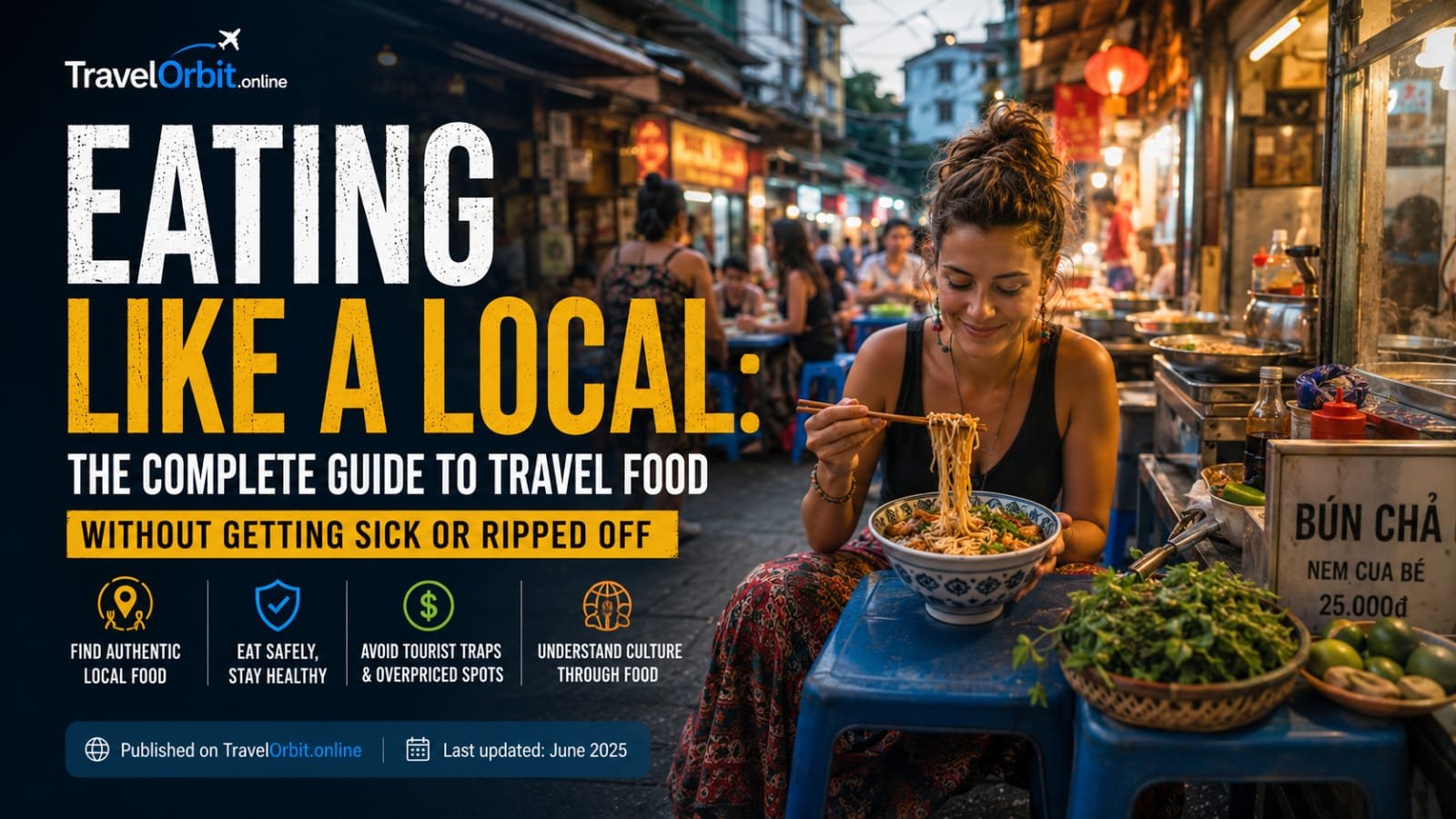
The best meal of my life cost $1.50 and was served from a cart with no name, parked on a corner in Hanoi that I couldn’t find again if I tried. No menu, no English, no Yelp reviews. Just a plastic stool, a bowl of bún chả, and an old woman who’d clearly been perfecting this exact dish for decades.
That meal taught me more about food travel than any guidebook ever did: the best food experiences are rarely the ones with the most reviews or the prettiest Instagram presence. They’re the ones rooted in genuine local practice, often hiding in plain sight, often intimidating to approach as an outsider.
This guide is about how to actually find and eat that food — confidently, safely, and in a way that respects the culture and people behind it.
Part 1: Finding Where Locals Actually Eat
The Signs That Distinguish Authentic From Touristy
Learning to read a restaurant’s actual character before you sit down saves you from both disappointing meals and inflated tourist prices.
Signs of an authentic, local-frequented spot:
Menu in the local language only, possibly handwritten or on a chalkboard
No one outside actively calling to passersby or showing laminated photo menus
Mostly local clientele, especially during lunch on a weekday
Prices listed without a currency symbol designed to look impressive to foreign visitors
Simple, unfussy decor — the investment is in the food, not the ambiance
Located slightly off the main tourist thoroughfare, often one or two streets back
Signs of a tourist trap:
Staff actively soliciting customers from the street, especially with aggressive friendliness
Laminated, photo-heavy menus in multiple languages
Located directly facing a major monument or tourist attraction
“Authentic” or “traditional” prominently featured in the name or signage (genuinely local spots rarely need to advertise their authenticity)
A doorman or host stationed specifically to intercept passing tourists
Practical Strategies for Finding Real Local Food
Walk away from the main square or attraction. The general rule across nearly every heavily touristed city in the world: food quality and value improve, often dramatically, the further you walk from the central tourist landmark. Two or three streets back is often enough to see prices drop by half and quality rise correspondingly.
Look for queues of locals, especially at lunch. Office workers and locals on lunch break have limited time and money — they don’t waste either on mediocre food. A line of local people, particularly during a weekday lunch rush, is one of the most reliable signals of genuine quality available to a traveler with zero local knowledge.
Ask people who work in the area, not your hotel concierge. Hotel concierges often have arrangements with restaurants that pay for referrals, which can bias recommendations toward business interests rather than genuine quality. Taxi drivers, shop owners, and people working (not staying) in the area tend to give more honest recommendations because they actually eat there themselves.
Use specific, local-knowledge resources. General platforms like TripAdvisor skew toward what other tourists rate highly, which often correlates with English-speaking staff and “safe” Western-friendly food rather than the best local options. Look instead for local food blogs, city-specific Reddit communities, and apps that locals themselves actually use (Dianping in China, Tabelog in Japan, Naver in Korea) — even if you need a translation app to navigate them.
Markets are reliably excellent. Wet markets, food markets, and night markets across most of the world offer some of the best, freshest, most authentic food available to travelers, typically at prices significantly below restaurant equivalents. The social etiquette is straightforward: point at what looks good, watch what locals order, follow suit.
Part 2: Eating Safely Without Being Overly Cautious
Separating Real Risk From Overcaution
Travel health anxiety around food is often disproportionate to actual risk, and overcautious eating frequently means missing some of the best experiences a destination offers. The goal is calibrated awareness, not blanket avoidance.
Genuine risk factors to watch for:
Food that’s been sitting out at room temperature for an extended period, particularly in hot climates (this applies to buffet-style food more than fresh-cooked street food)
Raw or undercooked meat, eggs, and seafood in destinations with less rigorous food safety infrastructure
Tap water in destinations where it’s known to be unsafe (and anything made with it: ice, fresh juice diluted with tap water, salads washed in tap water)
Unpasteurized dairy products in some regions
Food handled with visibly poor hygiene practices (though this is a less reliable indicator than people assume — busy, high-turnover stalls with constant fresh cooking are often safer than quiet ones with food sitting longer)
The “busy and fresh” principle: A street food stall with a constant stream of customers, where food is cooked to order in front of you over high heat, is generally one of the safest options available — turnover is fast, ingredients are fresh, and high cooking temperatures kill most pathogens. This is often safer than a quiet sit-down restaurant where food may have been prepared earlier and held.
Building Tolerance Gradually
For travelers new to destinations with different food safety standards than home, building gut tolerance gradually rather than diving into the most adventurous options on day one reduces the likelihood of getting sick.
A reasonable approach for the first few days in a new food culture:
Start with thoroughly cooked, freshly prepared foods
Be more cautious with raw vegetables and fruits you haven’t peeled yourself in the first 48 hours
Introduce street food and more adventurous options gradually as your system adjusts
Carry probiotics, which some travelers find helps gut adjustment (though evidence is mixed)
What to Do If You Do Get Sick
Travelers’ diarrhea is common enough that it has its own informal nickname in nearly every region of the world. It’s usually self-limiting and resolves within a few days with proper management.
Practical management:
Prioritize hydration — oral rehydration salts (available at any pharmacy, or pack some from home) are more effective than water alone for replacing lost electrolytes
The BRAT diet (bananas, rice, applesauce, toast) is a reasonable approach for the first day or two
Avoid dairy, alcohol, and very spicy or fatty foods until your system has recovered
Over-the-counter loperamide (Imodium) can manage symptoms for situations requiring travel, though it’s not a cure and shouldn’t be used if you have a fever or blood in your stool — these symptoms warrant medical attention
If symptoms persist beyond 3-4 days, include fever, or include blood, seek medical care
Part 3: Understanding Food Culture and Etiquette
Eating Etiquette Varies More Than You’d Expect
Table manners that feel like universal common sense at home can be genuinely offensive elsewhere, and vice versa. A few examples worth knowing:
Japan: Slurping noodles is not only acceptable but considered a compliment to the chef, indicating enjoyment. Conversely, never stick chopsticks upright in a bowl of rice (this resembles a funeral ritual) or pass food chopstick-to-chopstick (also a funeral association).
India and much of the Middle East: Eating with your right hand only is customary in many contexts, as the left hand is traditionally associated with hygiene practices. This varies by region and is becoming less rigid in urban areas, but is worth being aware of, particularly in more traditional settings.
France: Bread is placed directly on the table, not on your plate. Hands stay visible above the table (not in your lap) throughout the meal. Asking for substitutions or alterations to a dish is generally considered more impolite than in many other food cultures.
China: Leaving a small amount of food on your plate at the end of a meal traditionally signals that you’ve been given more than enough — finishing everything can imply your host didn’t provide adequate food. This custom is fading in some contexts but remains meaningful in others, particularly with older generations.
Ethiopia: Meals are often eaten communally from a shared platter using injera bread to scoop food, eaten with the right hand. The practice of “gursha” — feeding a piece of food directly to a dining companion’s mouth — is a significant gesture of respect and affection.
The broader principle: research basic etiquette for your specific destination before you go, and when uncertain in the moment, observe what people around you are doing and follow their lead. Most locals are forgiving of genuine, well-intentioned attempts to follow local custom, even imperfect ones.
Dietary Restrictions While Traveling
Traveling with dietary restrictions — vegetarian, vegan, gluten-free, allergies, religious dietary law — requires more preparation in some destinations than others.
Research before you go:
Learn key phrases in the local language for your specific restriction (printed translation cards, available through apps like SelectWisely, are invaluable for serious allergies)
Research which destinations have robust infrastructure for your needs — India and much of Southeast Asia have deep vegetarian traditions and abundant options; some destinations with meat-centric culinary traditions require more navigation
For serious allergies, carry necessary medication (EpiPen if applicable) and understand emergency protocols in your destination
HappyCow is an excellent resource for finding vegetarian and vegan-friendly restaurants worldwide, with a particularly strong database in major cities
Communicating restrictions clearly: A simple, clearly written card in the local language explaining your specific restriction (not just “vegetarian” but specifying whether that includes fish, eggs, or dairy, since definitions vary culturally) prevents miscommunication that could range from a disappointing meal to a genuine health risk for serious allergies.
Part 4: Food-Focused Travel Experiences
Cooking Classes — Learning the Why, Not Just the What
A good cooking class does more than teach you to replicate a dish at home — it teaches you the cultural logic behind a cuisine: why certain ingredients are paired, what role specific dishes play in daily life or celebration, how techniques have been passed down.
The best cooking classes typically include a market visit beforehand, where you learn to select ingredients alongside your instructor — this context dramatically improves the experience versus classes that simply hand you pre-measured ingredients.
Platforms like Cookly and Traveling Spoon connect travelers with vetted local cooking class hosts, often in home settings rather than commercial tourist-oriented venues.
Food Tours — Choosing the Right One
Food tours vary enormously in quality and authenticity. The better ones:
Keep groups small (6-8 people maximum)
Visit genuinely local establishments, not partner restaurants paying for tour traffic
Are led by guides with genuine local knowledge and connections, not generic tour company employees reading from a script
Include context about the history and culture behind the food, not just consumption
Research specific tour operators rather than booking generically — look for reviews mentioning specific dishes and locations rather than vague “great experience” feedback, which signals more genuine, detailed engagement from past participants.
Eating With Locals
Platforms like Eat with and Traveling Spoon connect travelers with local hosts who open their homes for meals, offering a level of cultural exchange and authenticity that restaurant dining, however good, can’t fully replicate. This is one of the most meaningful ways to experience a food culture from the inside, alongside genuine conversation with people who live there.
Part 5: Budget Strategies for Food Travel
Eating Well Without Overspending
The lunch strategy: Many destinations offer significant discounts on lunch menus at restaurants that charge considerably more for the identical experience at dinner. This applies from casual local spots to high-end establishments — research whether your destination’s food culture includes a strong lunch set-menu tradition (common across much of Europe and East Asia).
Market shopping for some meals: Even travelers without kitchen access can benefit from market shopping — fresh fruit, bread, cheese, and prepared foods for a picnic-style lunch dramatically reduce costs compared to sit-down meals for every eating occasion.
One splurge, several budget meals: Rather than spreading your food budget evenly across every meal, consider concentrating spending on one or two genuinely memorable dining experiences per destination, while keeping most meals simple, local, and inexpensive. This produces a better overall experience than mediocre meals at moderate prices throughout.
Street food as the budget backbone: In much of the world, street food represents extraordinary value — full, satisfying, often delicious meals for $1-5 in many countries. This isn’t a compromise; in many food cultures, the best version of a specific dish is found at a street stall, not a restaurant.
The Deeper Point of Eating While You Travel
Food is one of the most direct lines into understanding a culture available to a traveler. It carries history, geography, economics, family structure, and values in ways that are immediately, viscerally accessible — you don’t need to read a book about agricultural history to taste how a region’s climate and resources have shaped its cuisine over centuries.
Approaching food with curiosity rather than caution, respect rather than spectacle, and genuine appetite rather than performative adventurousness for social media — this is what transforms eating from a logistical necessity of travel into one of its central pleasures.
The $1.50 bowl of bún chả from the unnamed cart in Hanoi taught me that. I’ve been chasing that kind of meal, in one form or another, in every country I’ve visited since.
Find destination-specific food guides, restaurant recommendations, and culinary travel tips at TravelOrbit.online.
Tags: travel food guide, eating local while traveling, street food safety tips, how to find authentic local food, food travel tips 2026, foodie travel guide, eating safely abroad, best food destinations, culinary travel guide, food etiquette around the world
Eating Like a Local: The Complete Guide to Travel Food Without Getting Sick or Ripped Off