









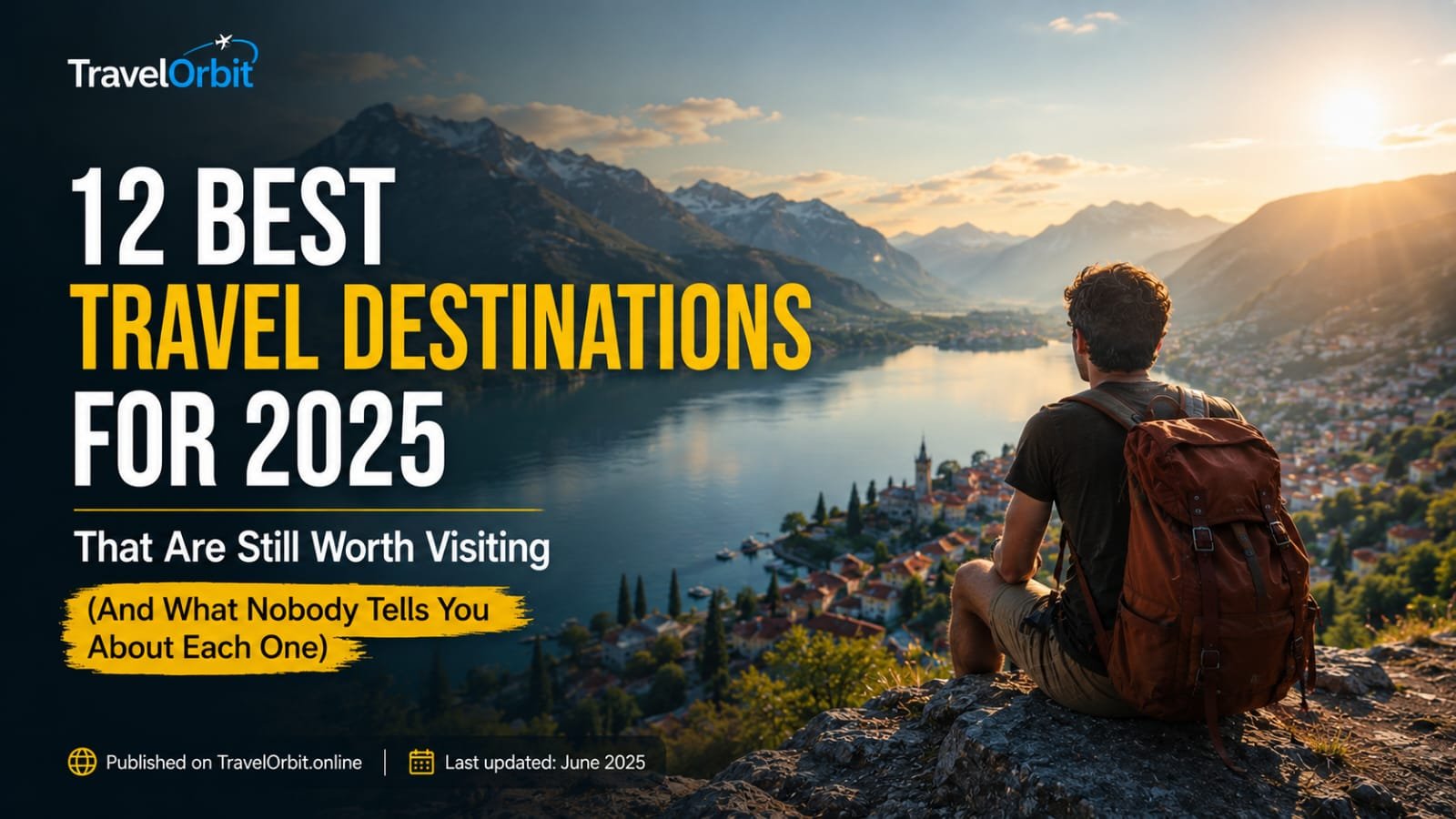
Every year, a fresh wave of “best travel destinations” lists gets published across the internet. They’re often gorgeous, sometimes useful, and almost always a little dishonest — because they tell you where to go without telling you what it’s actually like when you get there.
This list is different. I’m going to tell you what each destination is genuinely great for, who it’s best suited to, and what the honest catch is. Because every place has one.
These aren’t obscure locations chosen to impress you. They’re destinations that deserve their reputation — and a few that are quietly having their best moment right now.
- Japan — The World’s Most Thoughtfully Organized Country
Best for: First-time international travelers, solo travelers, food lovers, culture seekers
Honest catch: It can feel overstimulating and expensive if you’re not prepared
Japan has spent years at the top of travel wish lists, and the hype is earned. What makes Japan remarkable isn’t one thing — it’s the accumulation of a thousand details done exactly right. The trains that run on time to the minute. The ramen shop where the owner has been perfecting the same bowl for thirty years. The way strangers are simultaneously reserved and genuinely helpful.
Tokyo alone could absorb weeks of exploration — Shibuya’s controlled chaos, the quiet residential backstreets of Yanaka, the world-class contemporary art scene in Mori Art Museum, the izakayas where salarymen and students share tables late into the evening.
But Japan beyond Tokyo is where many travelers find their favorites. Kyoto’s temple districts in the early morning before tour groups arrive. Osaka’s street food scene, which has a legitimate claim to being the best eating city on earth. The rural ryokan experience — sleeping on futons, soaking in onsen, eating kaiseki meals served course by course.
The practical reality: Japan is not cheap, particularly accommodation. But food can be remarkably affordable — conveyor belt sushi and ramen shops deliver extraordinary quality for $8–15. Plan accommodation in advance, especially for popular seasons (cherry blossom in March–April, autumn foliage in November). - Portugal — Europe’s Most Welcoming Country
Best for: Budget travelers, solo travelers, digital nomads, food and wine lovers
Honest catch: Lisbon has gentrified significantly; prices are higher than five years ago
Portugal is having an extended moment — and the thing is, the moment is deserved. It’s the rare European country that manages to be simultaneously affordable, beautiful, culinarily excellent, and genuinely warm to visitors.
Lisbon rewards wandering. The seven hills, the miradouros (viewpoints) where locals and travelers gather at sunset, the Time Out Market which somehow avoided the fate of becoming a gimmick, the Alfama neighborhood where fado music drifts from restaurant windows at night.
Porto, two and a half hours north by train, is arguably even more charming. The riverside Ribeira district, the port wine cellars across the Douro, the extraordinary São Bento train station tiled in azulejos — it’s the kind of place where you sit down for a coffee at 11am and look up at 2pm.
The Algarve coast in the south is stunning but crowded in peak summer. For a quieter version of the same cliffs and ocean, explore the Alentejo region or the Silver Coast north of Lisbon.
The practical reality: Airfares from North America to Lisbon have become competitive. Accommodation in central Lisbon is more expensive than it was, but the Airbnb market outside the immediate tourist center still offers good value, especially for week-long stays. - Colombia — South America’s Most Surprising Comeback Story
Best for: Adventure travelers, foodies, culture seekers, those who want to feel the energy of a city on the rise
Honest catch: Some areas still require careful navigation; research before you go
Colombia’s transformation over the past two decades is one of travel’s most remarkable stories. Medellín — once synonymous with a very different kind of notoriety — is now regularly cited as one of the world’s most innovative cities, home to cable cars connecting hilltop neighborhoods, extraordinary modern architecture, and a food scene that punches far above the country’s global profile.
Cartagena’s old walled city is genuinely one of the most beautiful colonial urban environments in the Americas — pastel buildings, bougainvillea spilling over every balcony, Caribbean warmth in the air at all hours. The Coffee Region (Eje Cafetero) around Salento is spectacularly beautiful — mountain valleys covered in wax palms, tiny towns where coffee is grown, processed, and served all within a few kilometers.
Colombia also offers something increasingly rare: the feeling that you’re experiencing a place while it’s still finding its feet as a travel destination. That comes with some rough edges, but it also comes with genuine excitement and warmth.
The practical reality: Safety varies significantly by region. Bogotá, Medellín, Cartagena, and the Coffee Region are well-traveled and reasonably straightforward. Do thorough research before venturing to less touristed areas, and read up-to-date traveler reports rather than relying on older guides. - Morocco — A Sensory Overload in the Best Possible Way
Best for: Culture seekers, photographers, food lovers, travelers who want a complete change of scenery
Honest catch: The medinas are deliberately disorienting; harassment in tourist areas can be persistent
Morocco is a country that requires a certain willingness to be confused, at least at first. The medinas — ancient walled city centers — of Fez and Marrakech are intentional labyrinths where getting lost is essentially part of the experience. Lanes narrow to the width of a single donkey cart. The smell of spices gives way to leather tanneries, then to bread baking, then to nothing in particular.
Marrakech’s Djemaa el-Fna square at dusk — snake charmers and storytellers, food stalls and orange juice carts, the call to prayer echoing across the rooftops — is one of the world’s great spectacles and it’s been that way for centuries.
Beyond the cities, the Sahara Desert in the south is extraordinary. A night in a desert camp, watching stars appear in a sky unbothered by light pollution, is the kind of experience that becomes a reference point for the rest of your life.
The food is remarkable: tagines slow-cooked to perfect tenderness, pastilla (pigeon or chicken pie dusted with powdered sugar), pastries soaked in honey, mint tea poured from height to create the foam that signals proper preparation.
The practical reality: Bargaining is expected in the souks — the opening price is never the real price. Street harassment, particularly in Marrakech’s tourist areas, can be persistent. Traveling with guides (official ones hired through your riad) significantly reduces this friction. - Georgia (The Country) — Europe’s Best Kept Secret
Best for: Budget travelers, hikers, wine lovers, travelers seeking authentic cultural experiences
Honest catch: Infrastructure outside major cities can be challenging; limited international flight options
Georgia sits at the crossroads of Europe and Asia — literally, historically, and culturally — and has spent years being quietly extraordinary while the rest of the world looked elsewhere. That’s changing now, but it’s still early enough in its discovery arc that you’ll feel like you’ve found something real.
Tbilisi’s old town is an improbable collection of wooden balconied buildings, sulfuric bathhouses, Orthodox churches, mosques, and synagogues within walking distance of each other — a physical reflection of the country’s complicated, layered history.
The Caucasus mountains in the north, particularly the Kazbegi region, are genuinely dramatic. Gergeti Trinity Church perched on a hill above the village of Stepantsminda, with the snow-capped Kazbek mountain behind it, is one of those images that stops you mid-sentence.
And then there’s the wine. Georgia is possibly the oldest wine-producing region in the world, with an entirely unique tradition of fermenting wine in clay vessels (qvevri) buried in the ground. Amber and orange wines produced by this method have started attracting serious international attention.
The practical reality: Georgia is one of the most affordable countries in Europe by a significant margin. Accommodation, food, and local transport are all extremely inexpensive compared to Western European equivalents. - Vietnam — Long and Gloriously Diverse
Best for: Foodies, budget travelers, history seekers, beach lovers, backpackers
Honest catch: The country is long; trying to see all of it in one short trip is a mistake
Vietnam offers more variety per kilometer than almost any country on earth. The north — Hanoi’s chaotic motorbike energy, the extraordinary limestone formations of Ha Long Bay, the mountain towns of Sapa shrouded in mist — feels entirely different from the central coast’s ancient towns (Hội An’s lantern-lit streets at night are unforgettable) and different again from Ho Chi Minh City’s southern dynamism.
Vietnamese food culture is extraordinary and regional — pho from Hanoi tastes different from pho from Saigon, and both differ from Hội An’s white rose dumplings or the banh mi sold from carts on every corner for $1. Food here is hyper-local, seasonal, and taken seriously by everyone.
The practical reality: Vietnam is one of Asia’s great budget travel destinations — excellent food for $2–4, guesthouses for $15–25, and domestic flights between major cities often under $30. The tourist trail is well-worn but there’s significant room to step off it in the central highlands or less-visited northern provinces. - Iceland — Otherworldly, Expensive, Worth It
Best for: Nature lovers, photographers, adventurers, couples
Honest catch: It is genuinely expensive; budget carefully
Iceland sits in a category by itself among natural destinations. Nowhere else on earth feels quite like this: volcanic black sand beaches, waterfalls that drop into nothing, glaciers that crack with unsettling sounds, geysers erupting on schedule, and the Northern Lights rippling overhead in winter like a slow electrical fire.
The Ring Road — Route 1 that circles the entire island — is one of the world’s great road trip routes. Most travelers do it in 7–10 days, stopping at waterfalls and lava fields and tiny fishing villages.
Reykjavik, despite its small size, is a genuinely interesting city with a remarkable restaurant scene (notably for seafood), excellent coffee culture, and the kind of dark, dry humor that seems to be produced by long winters and volcanic landscapes.
The practical reality: Iceland is expensive by any measure. Accommodation, car rental, and eating out all cost significantly more than the European average. However, many of the best experiences — hiking, swimming in natural hot pools outside the tourist Golden Circle, watching the Aurora — are free or low-cost. - Mexico City — One of the World’s Greatest Cities
Best for: Food lovers, art and culture seekers, urban explorers
Honest catch: Altitude (7,300 feet) affects some travelers; parts of the city require care
Mexico City has, in the past decade, solidified its place among the world’s truly great urban destinations. The food scene is exceptional at every price point — from market stalls serving $1 tacos de canasta to internationally acclaimed restaurants that have drawn chefs and food writers from around the world.
The neighborhood of Condesa and Roma together form one of the world’s great walkable urban environments: art deco apartment buildings, mature jacaranda trees lining the streets, independent bookshops, natural wine bars, excellent coffee roasters. Coyoacán is quieter, more residential, anchored by Frida Kahlo’s blue house.
The archaeological sites — Teotihuacan an hour outside the city, with its two massive pyramids — and the extraordinary anthropology museum provide a counterpoint to the city’s modernity. This is a city that takes its history seriously.
The practical reality: Mexico City is increasingly expensive in tourist neighborhoods but still affordable by international standards. Accommodation ranges from excellent budget options to world-class boutique hotels. Safety requires urban common sense — stick to well-populated areas, use ride-sharing apps rather than street taxis, and follow advice from current traveler reports. - Sri Lanka — The Teardrop of India
Best for: Culture seekers, wildlife lovers, tea enthusiasts, beach travelers
Honest catch: Getting between destinations takes longer than you’d expect; plan conservatively
Sri Lanka packs extraordinary variety into a small island. Ancient ruins, UNESCO World Heritage sites, wildlife safaris where elephants outnumber tourists at dawn, beautiful beaches on multiple coasts for different seasons, and the tea-covered central highlands — all within a day’s drive of each other, at least in theory.
Kandy’s Temple of the Tooth, the cave temples of Dambulla, the fortress palace of Sigiriya rising from the jungle — the cultural triangle in the north-center of the island alone justifies a trip. The southern coast’s surf scene around Arugam Bay has developed a loyal following. The hill country around Ella offers the kind of green, misty, productive beauty that you want to photograph every five minutes and then feel guilty about doing.
The practical reality: Sri Lanka has faced economic challenges in recent years, and there’s genuine value in traveling there now — both because prices remain affordable and because the tourism sector genuinely needs the support. - Greece — Underrated Beyond the Islands
Best for: History lovers, food lovers, hikers, beach travelers
Honest catch: The islands are overcrowded in peak summer; mainland Greece deserves more attention
Everyone knows the postcard version of Greece — Santorini’s blue-domed churches, the turquoise Aegean, tables of mezze by the water. These are real and genuinely beautiful. But the crowds in peak summer on Santorini and Mykonos are genuinely difficult.
The better kept secret: mainland Greece is spectacular and far less visited. The Peloponnese region, with its Byzantine ruins, hiking the Mani peninsula, and small ports serving grilled octopus and cold wine — this is Greek travel at its best. Athens itself deserves more time than the single day most visitors give it.
The practical reality: Shoulder season (May and September/October) transforms the island experience — same weather, fraction of the crowd. The Greek mainland is consistently undervisited relative to its quality. - New Zealand — Small Country, Outsized Landscapes
Best for: Hikers, adventure sports, nature lovers, road trippers
Honest catch: It’s a long flight from almost everywhere; factor this into your planning
New Zealand is the rare destination that consistently exceeds expectations even for people who’ve seen many beautiful places. The South Island in particular — Fiordland, Queenstown, the Milford Sound, the Mount Cook region — offers alpine landscapes on a scale that regularly makes visitors stop their cars on the highway just to stare.
The North Island has its own character: volcanic plateau with thermal activity around Rotorua, the gorgeous Northland beaches, and Wellington, which has perhaps the most disproportionately good food and coffee scene of any city its size on earth.
The practical reality: New Zealand requires a longer trip to justify the travel time — two weeks minimum, three weeks ideal. It’s moderately expensive, but campervan rental (extremely popular among visitors) can significantly reduce accommodation costs while adding flexibility. - Oman — The Middle East’s Most Underrated Destination
Best for: Desert lovers, history seekers, divers, travelers looking for genuine peace and quiet
Honest catch: Limited public transit; a car rental is essentially required
While its neighbor Dubai gets most of the attention, Oman quietly offers something more interesting: genuine culture, extraordinary landscapes, and a pace of life that hasn’t been entirely subsumed by development.
Muscat, the capital, is a pleasant, surprisingly green city — strict building regulations mean everything is low-rise and white, giving it a calm that larger Middle Eastern cities lack. Beyond the capital: the dramatic Hajar Mountains, the vast Wahiba Sands desert, the deep green gorge of Wadi Bani Khalid, the dolphin-rich waters of the Musandam peninsula.
Oman is one of the safer destinations in the region for Western travelers, and Omanis have a reputation for hospitality that travelers consistently remark upon.
How to Actually Choose
Reading a list like this can create its own kind of overwhelm. Here’s a simple filter:
Choose Japan or New Zealand if you want organization, safety, and natural/cultural beauty without too much stress.
Choose Portugal, Colombia, or Georgia if you want affordability, warmth, and the feeling of somewhere still finding its feet.
Choose Morocco or Vietnam if you want maximum sensory richness and cultural difference from Western experience.
Choose Iceland or Oman if you want landscapes that feel genuinely unlike anywhere you’ve been.
Every destination on this list rewards travelers who arrive curious rather than expectant. The places that surprise you most are often the ones you arrived with the lowest expectations.
Explore detailed destination guides, itineraries, and travel tips for every country on this list at TravelOrbit.online.
Tags: best travel destinations 2025, most beautiful countries to visit, top travel destinations, where to travel in 2026, best countries for tourists, travel bucket list, international travel destinations, places to visit before you die