








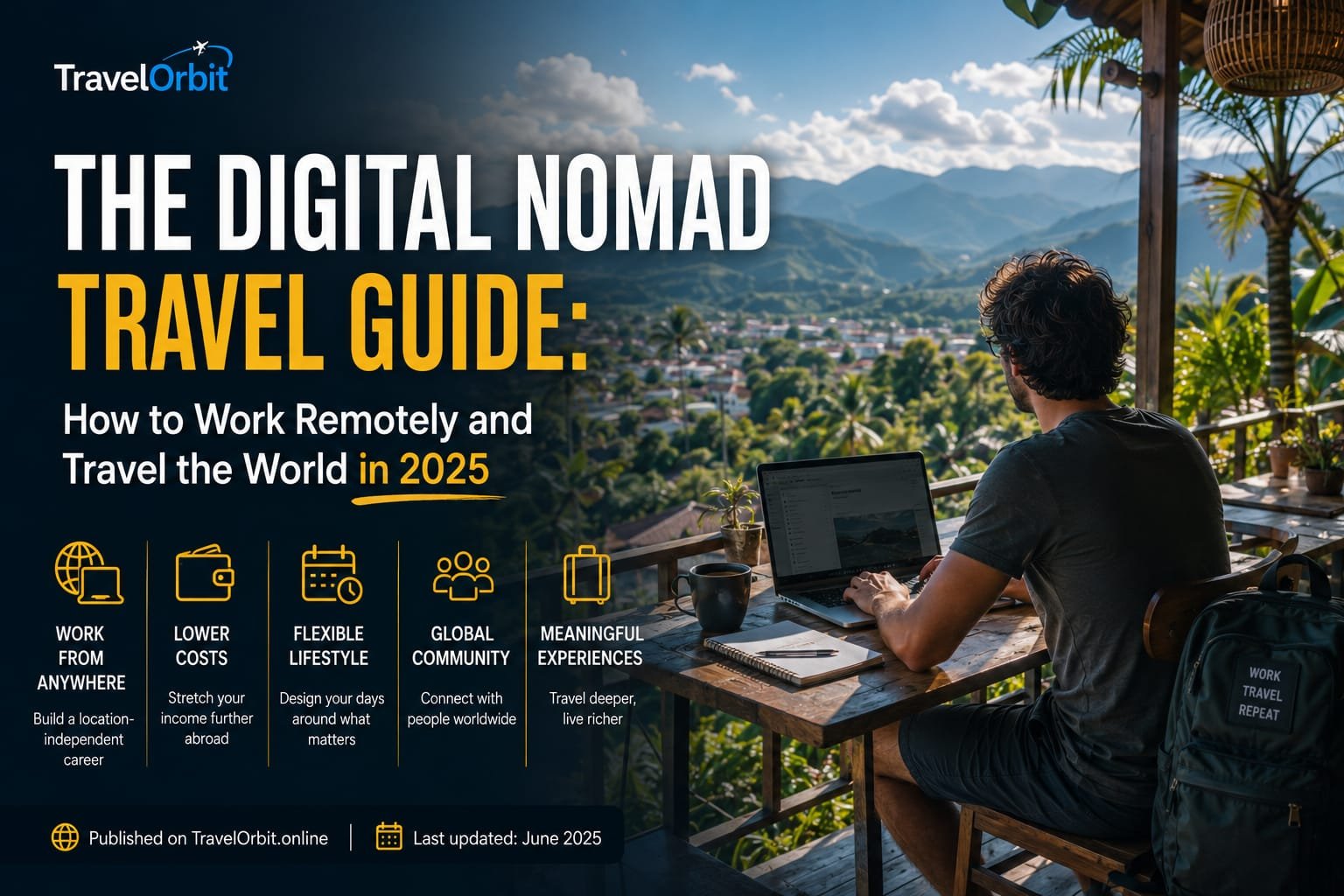
Four years ago I was sitting in a cubicle in Chicago doing a job I was competent at but not passionate about, spending fifty-two weeks a year in a city I’d never consciously chosen to live in. Today I’m writing this from a café in Chiang Mai, Thailand. My rent is $450 a month for a studio apartment with mountain views. My internet is faster than what I had in Chicago. I’m earning more than I did in the cubicle.
I’m not telling you this to brag. I’m telling you this because four years ago I thought the digital nomad lifestyle was reserved for tech founders, freelance photographers, and people with inheritances. I was wrong, and I want to tell you exactly how this works for people who don’t fit those categories.
The remote work revolution has genuinely changed what’s possible. In 2020, roughly 6% of American workers worked fully remotely. By 2025, that figure has grown significantly, and with it, the infrastructure, visa options, community, and practical knowledge that makes working while traveling not just possible but genuinely sustainable.
This guide covers the practical reality the finances, the visas, the workspace realities, the loneliness, and the extraordinary upside of building a life that combines meaningful work with serious travel.
Part 1: What Digital Nomadism Actually Looks Like in 2025
The Range of Experiences
“Digital nomad” covers a wide range of lifestyles that don’t all look the same:
The slow traveler: Spending one to three months in each location, renting an apartment, joining co working spaces, building temporary community. This is the most sustainable version for most people and the one that actually allows you to experience a place rather than just transit through it.
The fast traveler: Moving every few weeks, staying in hotels or short-term rentals, seeing more places but going deeper in none. More exhausting than it looks in Instagram posts; most people who try this converge on slower travel within six months.
The base + exploration model: Establishing a primary base in a low-cost, pleasant city while taking shorter trips from that base. This is increasingly popular it provides stability while maintaining the freedom to explore.
The location-agnostic employee: Someone with a remote job who travels during legitimate work time, staying within employer-defined time zones or requirements while working from wherever they want.
Each has different requirements, costs, and tradeoffs.
What’s Changed Since 2020
The remote work boom has created significant infrastructure for nomad travel:
Digital nomad visas now exist in over 50 countries, providing a legal path to working remotely for extended periods without traditional work permit requirements
Coworking spaces have proliferated in major nomad hubs; quality has improved dramatically
Nomad communities (online and in-person) are more established and accessible
Employer attitudes toward remote work have normalized significantly — the argument for working from abroad is much easier to make in 2026 than it was in 2019
Part 2: Getting Remote Work Before You Go
Negotiating Remote with Your Current Employer
If you have a job you like and it can be done remotely, the first option to explore is negotiating remote work with your existing employer before looking elsewhere.
The approach that works best:
– Build a track record of excellent remote performance if you’ve had any hybrid or remote time
– Propose a trial period rather than a permanent arrangement upfront
– Address the employer’s likely concerns proactively: communication, availability, time zones, security
– Have a specific proposal “I’d like to work remotely from Portugal for three months while maintaining my current schedule in GMT-5” rather than a vague request
The success rate for these conversations has improved significantly. Many employers have discovered that remote workers are often more productive and that the fear of timezone and communication challenges was overstated.
Finding Remote-First Jobs
If your current employer won’t accommodate remote work, the job market for remote roles has expanded substantially. Key resources:
We Work Remotely — one of the oldest and most reliable remote job boards
Remote. co curated remote jobs across a wide range of fields
FlexJobs broad range including part-time and flexible remote roles LinkedIn with the “Remote” filter — increasingly effective as more companies designate roles formally remote
Otta particularly strong for tech and startup roles
Fields with the most remote opportunity: software development, UX/UI design, digital marketing, content writing, data analysis, product management, customer success, financial analysis, online education.
Building Freelance Income
Freelancing is the other path to remote income and the one with the most independence — you’re not tied to any single employer’s time zone requirements or travel policies.
The honest reality: freelancing requires a longer runway to build reliable income. You’ll typically need six to twelve months of savings, or a part-time arrangement that funds the early freelance period.
Where to start building freelance clients:
– Upwork and Fiverr for initial clients and portfolio building (lower rates initially, better for building reputation)
– Toptal, Guru, and specialized platforms for higher-rate professional services
– Your existing professional network — the best early freelance clients are almost always people who already know your work
– Content platforms (Substack, Medium Partner Program) for writers building audiences
Part 3: Digital Nomad Visas — Your Legal Path
Why Visas Matter More Than Most Nomads Admit
The majority of digital nomads technically work in legal grey zones — visiting countries on tourist visas while earning income, which is often a violation of visa terms even when technically unenforceable.
This is worth taking seriously for two reasons: the risk of visa violations (rare but real, particularly in countries that have become stricter with nomads), and the peace of mind of working legally.
The good news: the legal landscape has shifted significantly. Over 50 countries now offer dedicated digital nomad or remote work visas.
The Best Digital Nomad Visas in 2026
Portugal’s Digital Nomad Visa (D8 Visa): One of the most popular, allowing remote workers to live in Portugal for up to one year with renewal options. Requires proof of minimum monthly income (around €3,040/month as of 2024) and health insurance. Portugal’s combination of cost of living, climate, food, and quality of life makes it one of the most compelling nomad destinations.
Spain’s Digital Nomad Visa: Launched in 2023, aimed at remote workers with non-Spanish clients/employers. Requires income above 200% of Spain’s minimum wage, valid for up to five years with renewal.
Greece’s Digital Nomad Visa: One-year visa with potential for renewal; income requirements approximately €3,500/month. Athens and the islands both offer different experiences for remote workers.
Estonia’s Digital Nomad Visa: Small, tech-forward country with excellent digital infrastructure and a fascinating city in Tallinn. Valid for one year.
Thailand’s Long-Term Resident (LTR) Visa: Thailand has formalized long-term residency options for remote workers, providing legal clarity in one of the world’s most popular nomad destinations. Income requirements are higher ($80,000+ annual income for the standard LTR visa).
Bali, Indonesia:Indonesia’s digital nomad visa (launched 2023) gives remote workers legal status in one of the world’s most beautiful destinations.
Latin American options: Colombia, Costa Rica, Ecuador, and Panama all offer versions of remote worker or digital nomad visa programs, generally with more straightforward income requirements than European options.
Part 4: The Practical Realities of Working While Traveling
The Workspace Problem
Working from cafés sounds romantic. It is, for the first two weeks. After that, unreliable Wi-Fi, uncomfortable chairs, background noise, and the social complexity of nursing a single coffee for four hours while occupying a table starts to wear.
The sustainable workspace solution for most digital nomads: a combination of a dedicated coworking space membership (2–4 days per week) and a suitable home base (apartment with a desk, good internet, and reasonable quiet).
Coworking spaces in major nomad hubs are excellent and affordable:
– Chiang Mai: excellent spaces from $100–$200/month
– Medellín: $80–$150/month
– Lisbon: $150–$300/month
– Bali (Canggu): $100–$250/month
– Tbilisi: $80–$150/month
Services like Coworker.com allow you to search and compare coworking spaces globally. Many offer day passes if you’re testing a city before committing.
Internet Reliability — More Important Than You’d Think
Poor internet is the most career-damaging problem a digital nomad faces. Research internet quality for any destination before committing.
Tools for research:
– Nomad List (nomadlist.com) crowd-sources data on internet speeds, cost of living, safety, and other factors for hundreds of nomad-friendly cities
– Speedtest.net for testing actual speeds at specific locations
– Asking in nomad Facebook groups and Reddit communities (r/digitalnomad) for current ground-level reports
Backup solutions:
– A local SIM card with a large data plan for tethering is non-negotiable as a backup
– Some nomads carry a portable hotspot device as an additional layer
– Know the nearest coworking spaces in any city you’re staying in — they’re your emergency backup when accommodation internet fails
Managing Time Zones
This is the most practically complex element of working remotely while traveling extensively. The solutions depend on your specific situation:
Fully asynchronous work (common in tech, writing, and some management roles) is time zone agnostic — you work when you want as long as deadlines are met. This provides maximum travel flexibility.
Synchronous requirements (regular video calls, client-facing work) require overlap with employer or client time zones. This doesn’t prevent travel — but it constrains which destinations work. A US-based employee can comfortably work from Europe (3–9 hour difference, with morning overlap) or South America (1–3 hours, easy overlap). Working from Southeast Asia on a US schedule (12–15 hour difference) requires either working odd hours or having maximum schedule flexibility.
Being honest with employers about your location and the time zone implications — rather than pretending you’re somewhere you’re not — is both ethically important and practically easier to sustain.
Part 5: The Best Cities for Digital Nomads
Chiang Mai, Thailand
Consistently rated among the world’s top nomad destinations for good reasons: excellent and affordable coworking spaces, reliable fast internet, superb food scene, easy access to nature, genuinely low cost of living, and a large established nomad community that makes the social side of nomad life considerably easier.
A comfortable nomad life in Chiang Mai — good apartment, coworking membership, excellent food daily — runs $1,200–$1,800/month.
Medellín, Colombia
Medellín has transformed itself into one of South America’s great cities for remote workers. Year-round spring-like climate (it’s called the “City of Eternal Spring”), excellent coffee, a thriving coworking ecosystem in the El Poblado and Laureles neighborhoods, and a cost structure significantly lower than North American or European cities.
Budget: $1,400–$2,200/month for a comfortable lifestyle.
Lisbon, Portugal
Europe’s most popular nomad destination and increasingly expensive, but still significantly more affordable than London, Paris, or Amsterdam. Excellent food and wine, extraordinary historic architecture, warm climate, English widely spoken, and EU legal status for those with European passports or the D8 visa.
Budget: $2,000–$3,500/month for a comfortable lifestyle in Lisbon or Porto.
Tbilisi, Georgia
The most underrated nomad destination on this list. Extraordinarily affordable (comfortable apartments from $400–$600/month), visa-free entry for most nationalities for up to 365 days, excellent and fast-developing coworking infrastructure, fascinating food and wine culture, and a warmth toward foreigners that’s genuinely striking.
Budget: $900–$1,500/month comfortable.
Bali, Indonesia (Canggu / Ubud)
Bali has its own gravitational pull for nomads — and the concentration of coworking spaces, nomad-friendly cafés, and community events in Canggu is genuinely remarkable. Ubud offers a quieter, more nature-oriented alternative. The recent digital nomad visa has clarified the legal situation.
Budget: $1,200–$2,000/month comfortable.
Part 6: The Emotional Reality of the Nomad Lif
The Things No One Tells You
Relationships are harder. Maintaining close friendships and romantic partnerships while moving regularly requires more intentionality than most nomads anticipate. Video calls are not the same as being there. Relationships that survive require active investment.
The novelty wears off. After a certain number of cities, the excitement of “somewhere new” becomes background noise. This is when nomads either go deeper (spending more time in fewer places, building community) or burn out (returning home having exhausted the constant-movement model).
**FOMO runs in both directions.** You’ll experience FOMO about home — friends’ milestones, family events, the community you left. And friends at home will experience FOMO about your life that changes their perception of you in ways that can create distance.
It’s not a permanent escape. The psychological challenges you had before you started traveling generally follow you. The nomad lifestyle offers perspective and growth but isn’t a substitute for doing the internal work that any meaningful life requires.
What Makes It Sustainable Long-Term
The digital nomads who sustain this lifestyle for years — rather than burning through a year and returning exhausted — tend to share a few characteristics:
– They move slowly, spending months rather than weeks in each place
– They invest in building real community wherever they are, not just collecting travel acquaintances
– They maintain meaningful work that they care about, not just remote jobs that fund travel
– They stay connected to home — relationships, family, a sense of continuity — rather than trying to entirely leave their previous life behind
Is This Life for You?
The digital nomad lifestyle isn’t for everyone. It requires tolerance for uncertainty, comfort with solitude, the discipline to work productively without external structure, and a genuine interest in the world beyond your home country.
For people who have those qualities, it offers something extraordinary: the ability to design a daily life in which work, travel, freedom, and community coexist in a way that few previous generations of non-wealthy people had access to.
That’s not nothing. In fact, for the right person, it might be exactly everything.
Find coworking guides, nomad visa resources, and remote work destination reviews at [TravelOrbit.online](https://travelorbit.online).
Tags: digital nomad guide 2026, how to work remotely while traveling, digital nomad visa, best cities for digital nomads, remote work travel, work from anywhere, digital nomad lifestyle, nomad travel guide, best countries for digital nomads, remote work abroad